Post
The AI conundrum
Will AI usher in an era of material abundance?

Artificial Intelligence is here. It has come to completely revolutionize our lives, or so the founders behind it would have us believe:
«“Humanity is about to be handed almost unimaginable power, and it is deeply unclear whether our social, political, and technological systems possess the maturity to wield it.”».
Dario Amodei, 2026.
«“Artificial intelligence will reshape the material conditions of human life on a scale that no technology has accomplished since the harnessing of electricity, and perhaps beyond even that.”».
Sam Altman, 2026.
Can we really dream of a cool and abundant future? Will AI dramatically improve our lives? Unfortunately for the reader, I think I am neither capable nor fit to answer these grand questions. But, I just wanted to share some insights from recent data and my overall feeling about where we are headed. For that, I must warn the reader that I will put my economist hat on.
A useful framework
Economists theorize about how we produce goods and services leveraging mathematical equations. An equation that has provided great insights is what they call the production function. This equation maps inputs—like labor and capital—into outputs, like cars. Note that in the equation shown below, there is also an A: this is what economists call Total Factor Productivity, which captures the efficiency with which capital and labor are combined. Economists usually think of knowledge and institutions when discussing A. So this equation allows us, for example, to see how much of production growth is due to just having more inputs, or due to actually being able to combine these inputs in a more efficient way.
$$ Y = A K^{\alpha} L^{1-\alpha} $$Where \(Y\) denotes output, \(A\) productivity, \(K\) capital, \(L\) labor.
One of the main insights of the Solow Model, which relies on such a production function to map the whole economy, is that sustained welfare increases per worker can only come from sustained increases in total factor productivity, as capital deployment is bounded by the law of diminishing returns. Therefore, this framework implies that AI would bring about a revolution in living standards if it manages to continuously increase total factor productivity. I want you to keep this in mind from here on.
The evidence on AI and productivity
Luckily for us, a hoard of researchers have rushed to investigate the effects of AI adoption on productivity.
On the one hand, there are “micro" studies that look at how using AI impacts the ability of people to perform specific tasks. These are seen as reliable because they effectively isolate the effect of AI from other confounding factors by carefully constructing an experiment with a bunch of random individuals. Estimates range from 5% up to 50% depending on the task. It is safe to say that there is strong evidence that individuals are able to perform specific tasks more efficiently when using AI. Think of how much it took you to code, or write emails before and after AI.
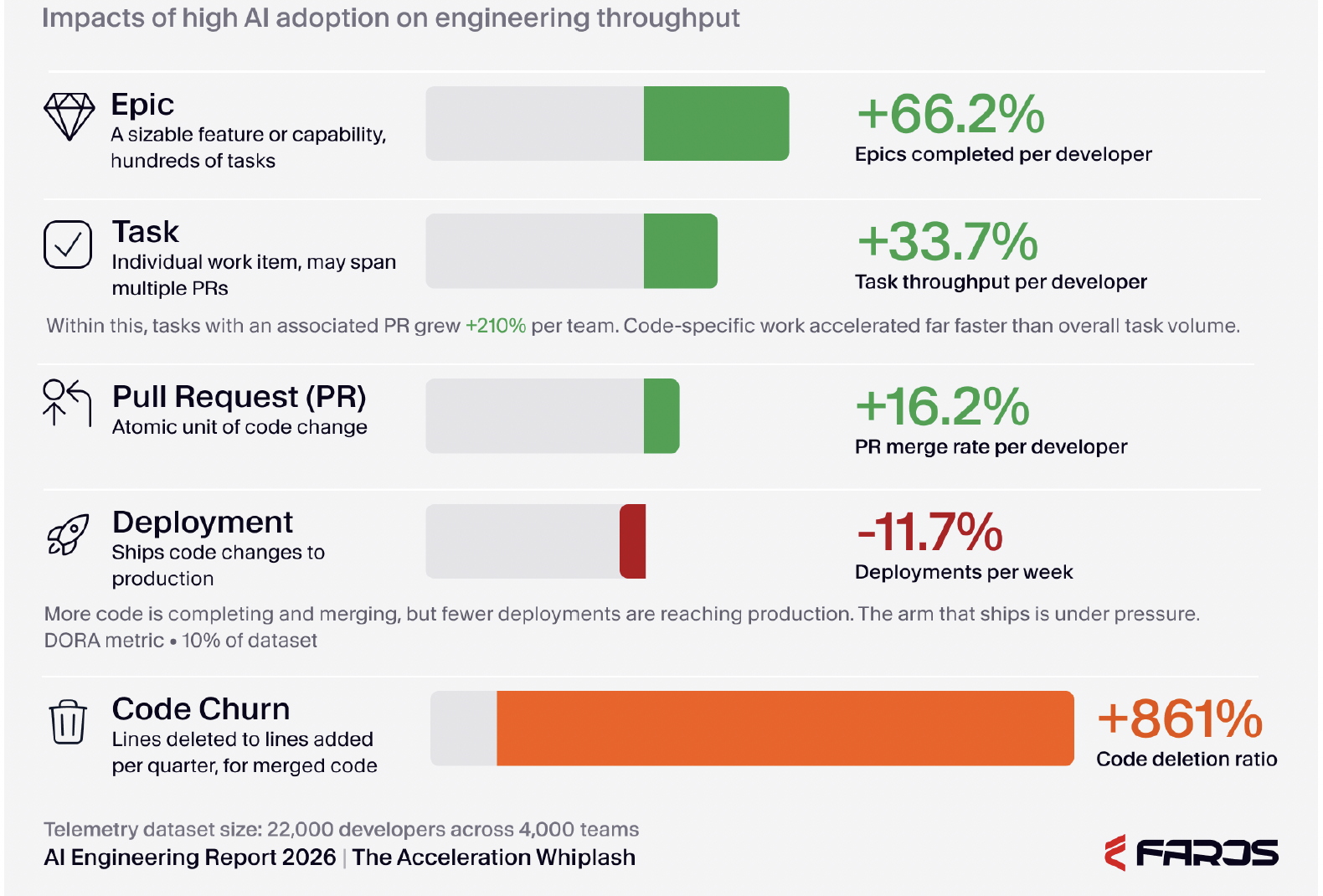
However, that a specific tool improves the ability of individuals to perform specific tasks does not imply that Total Factor Productivity would rise. First, if such a tool was expensive, incorporating it in the production process would not be necessarily profitable. In this regard, the cost per token has been increasing, and according to Forbes, “analysts project that when pricing normalizes to reflect real infrastructure costs, enterprise AI bills rise another 30% to 50% above current levels”. Second, the tool may have unintended consequences outside of the specific evaluated task. For example, a study that carefully tracked software companies’ production process changes after AI adoption, shows that while AI enables programmers to increase their initial code output, it also slows down the reviewing process and makes more mistakes, with the end result being less actual code delivered to the clients.
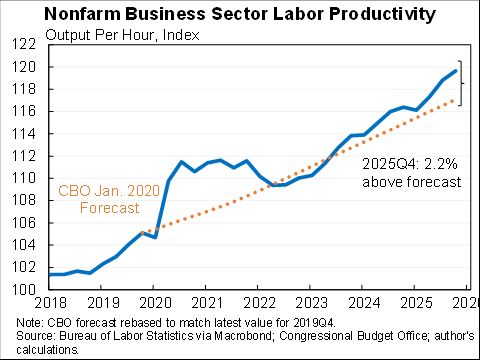
In fact, the macro data is still not showing signs that a technological revolution is underway. You will see some economists that want the ear of Silicon Valley say that you can see signs. For example, one of the most followed academics on the matter, Alex Imas (who works for Google btw), believes that the newest batch of macro data does reflect productivity gains from AI. In his post, he points to this graph about the recent performance of labor productivity compared to its pre-pandemic trend as evidence of AI gains. I think that is wishful thinking.
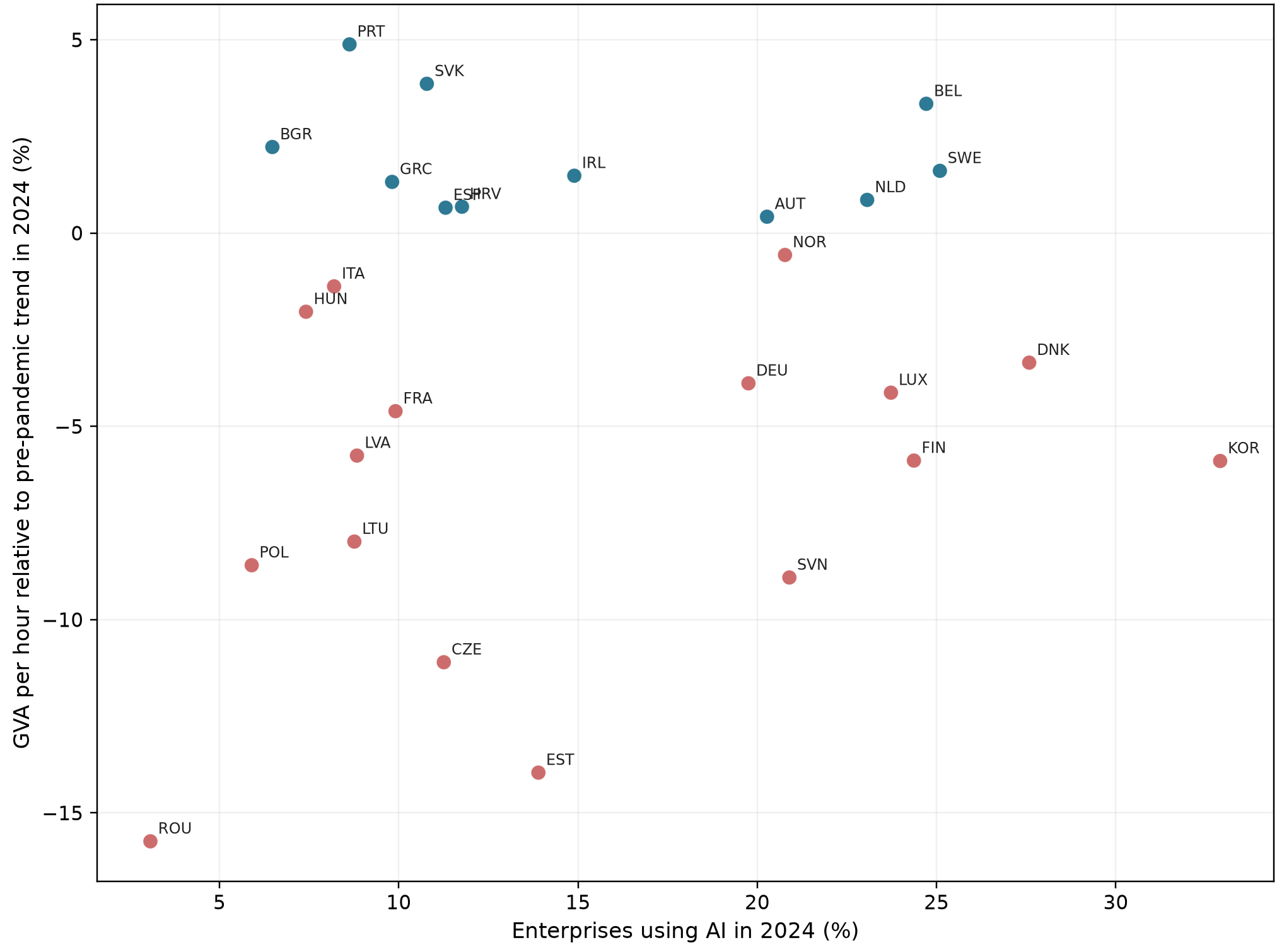
If you repeat the same exercise for European countries and other advanced economies and plot AI diffusion against the labor productivity distance with respect to the pre-pandemic trend, you will find no significant or discernible correlation whatsoever. While correlation is not causation, the absence of greater productivity gains in countries where AI is more widely used is observable evidence worth noting when evaluating whether AI is bringing about a revolution in productive efficiency.
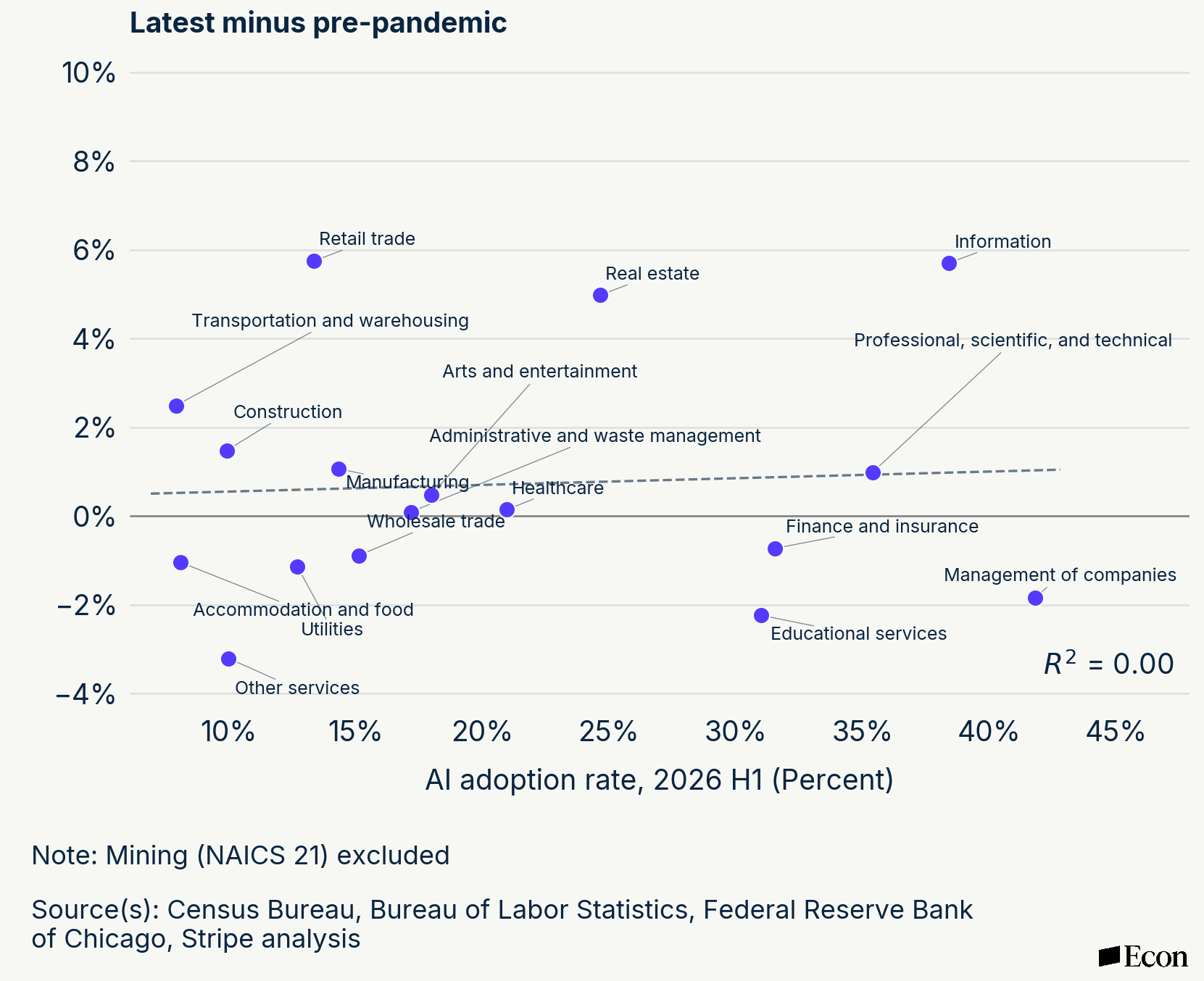
On top of this, if AI was driving the recent uptick in labor productivity in the United States, you would think that the sectors that would be accelerating would be those that use more AI. However, there is no correlation at the sectoral level between labor productivity growth and AI adoption after controlling for pre-pandemic growth trends.
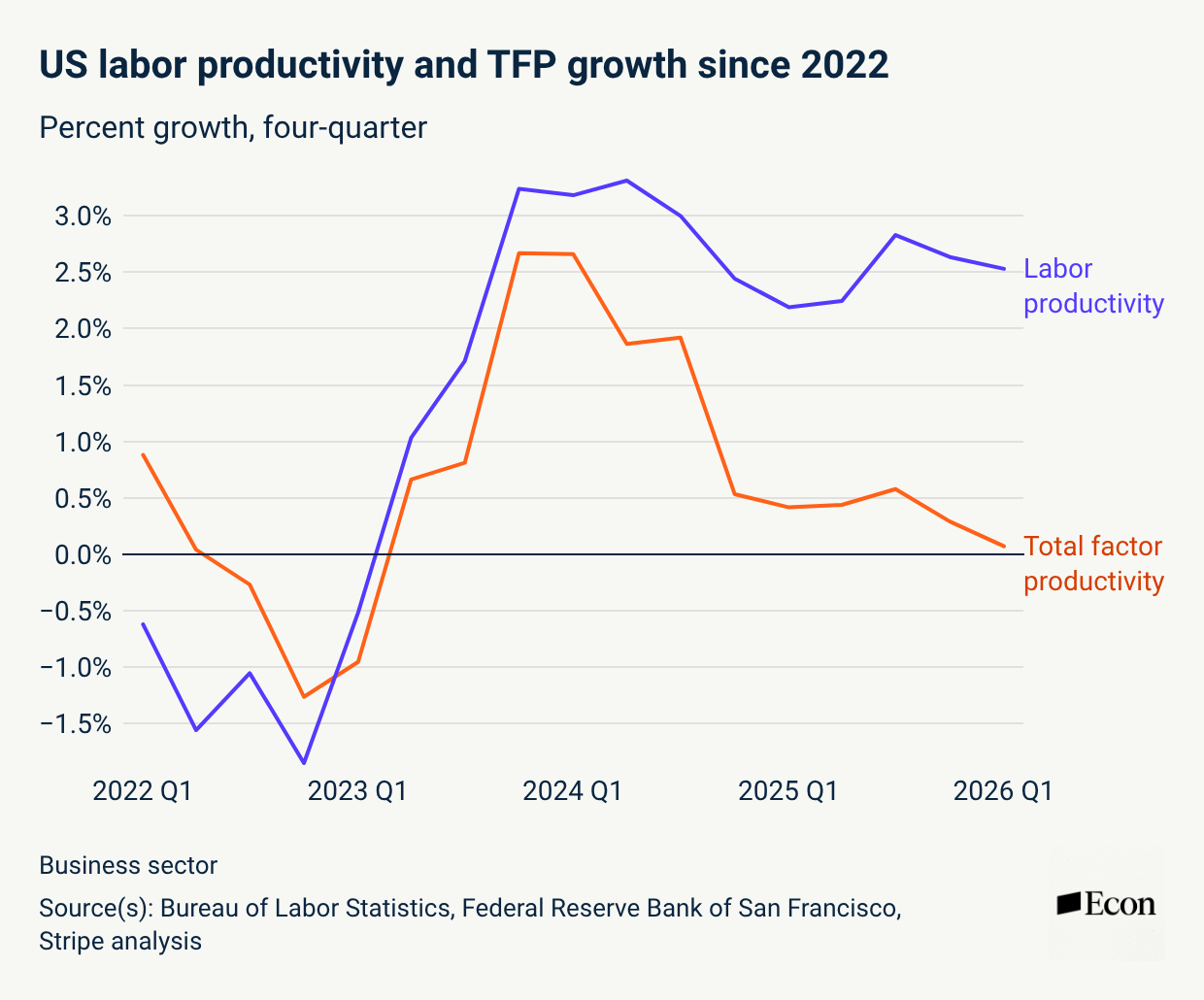
Also, remember that what drives long-run prosperity is Total Factor Productivity, not labor productivity necessarily. In his brilliant post, Ernie Tedeschi, former Chief Economist of the Council of Economic Advisers to the White House, estimates Total Factor Productivity for the United States, and finds that it has decoupled from labor productivity. It turns out that the recent uptick in Labor productivity may just be because workers have more capital to work with (companies are running their capital hot by spending a lot on AI, data centers, compute…).
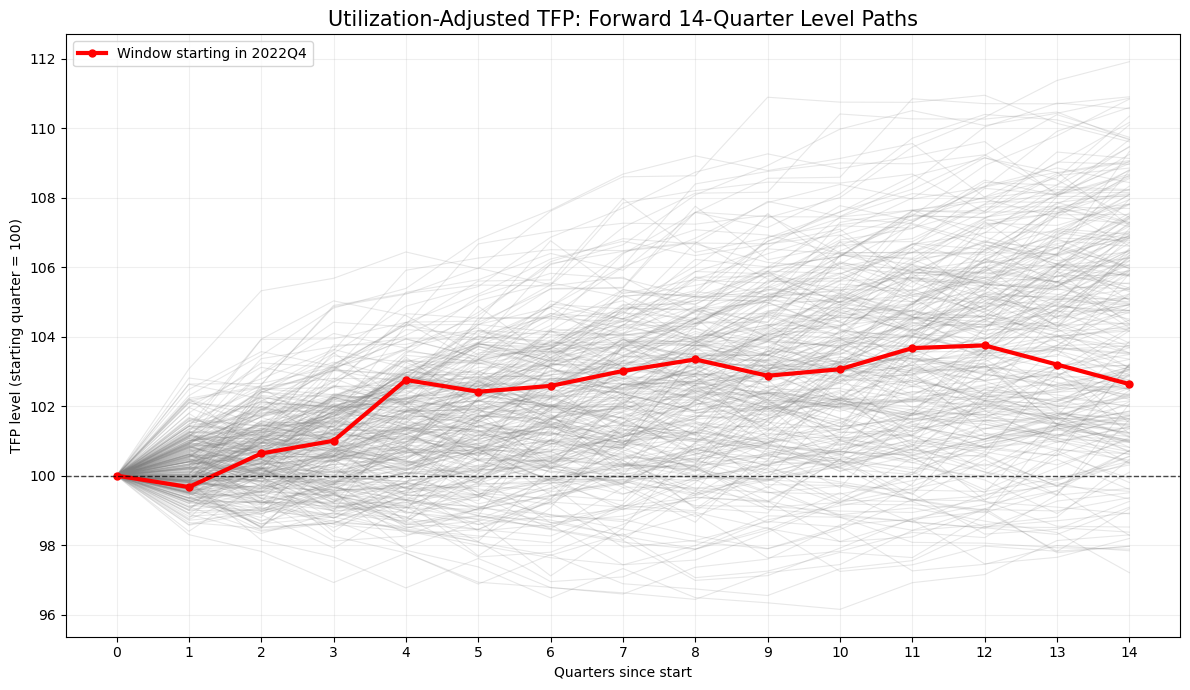
Lastly, Total Factor Productivity growth since ChatGPT was released has been average or relatively weak by historical standards. In the graph, the highlighted red line shows the evolution of TFP since ChatGPT was released, while each grey line represents an equivalent-length path beginning in each single quarter since 1947. As of 2026, the post-ChatGPT trajectory lies near or below the median of these historical paths.
To sum up, there is a lot of evidence of AI improving task-level efficiency, and no clear evidence that the economy’s productivity is speeding up due to AI. This has led researchers to discuss potential bottlenecks that explain this disconnect. For example, a study by the central bank of South Korea, which finds that AI is not leading to productivity gains for its economy, highlights two main bottlenecks: workflow rigidities in the workplace (“a software developer who can write code twice as fast still has to wait for code reviews, attend meetings, coordinate with teammates”), and misaligned worker incentives (workers may respond to task level efficiency gains from AI by putting less effort). The presence of bottlenecks seems a plausible justification for the micro-macro disconnect, but it could also be “tech-bro cope”.
Have we seen this before?
The ICT (fancy term for computers and the internet) revolution also gave us high hopes about our future productive capabilities. Think about how faster email is compared to traditional mail, compare modern computers versus the typewriter when it comes to creating and editing documents, or consider how easier it is to do research on the world wide web versus a physical library. Here is a quote from the important CEOs at the time on how they believed computers and the internet would shape the future:
«“We have the opportunity to double productivity and the standard of living in one generation, or two.”».
John Chambers, 2001
«"“The information highway (the internet) will transform our culture as dramatically as Gutenberg’s press did the Middle Ages.”».
Bill Gates, 1996
Computers and the internet had a profound impact on a wide array of tasks and may well have transformed entire organizational workflows. They created new markets, giant companies, and new spaces in which our social, cultural, and political identities develop. But, they did not usher in an era of material abundance. In fact, the United States experienced slower Total Factor Productivity growth in the 90s and 00s than in the 50s and 60s.
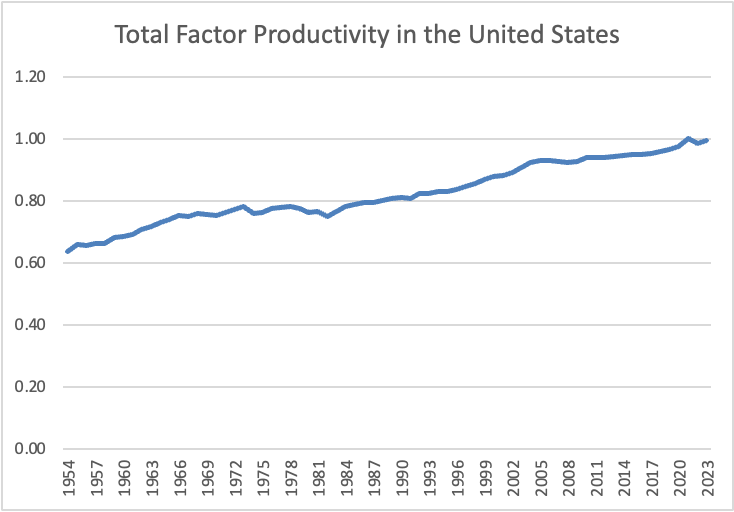
At the time, the absence of a productivity acceleration following the mass adoption of ICT caught the eye of many economists. There is a famous quote from Robert Solow that goes “the computer age can be seen anywhere but in the productivity statistics”. So, maybe, just maybe, it could be that the AI age will be seen anywhere but in the productivity statistics. And if that is the case, financial markets are in big trouble, because they are banking heavily on the success of this tech.